Memories from Xiahe (2011)
For recorded soundscape and interactive system
The noise should be as loud as you can take, overwhelming. The first incoming at 50 seconds can be used as reference level. If loud, do not use in-ear headphones because the piece has high frequency content and it could be harmful.
Duration: about 10 minutes
Channels: 2
In August 2007 I set off from Beijing towards the inner China, without a clear plan. Led by travelmates met along the way, I ended up in Xiahe. Here there is the Labrang Monastery, with its perimeter strewn with 1174 prayer wheels. The prayer wheel (mani-chuskor) consists of a cylinder containing a long scroll of paper bearing countless repetitions of the tibetan mantra "Om! Mani padme hum" (literally "Hail! Jewel in the lotus"). Some of the largest prayer wheels are said to contain as many as a million printed repetitions of the ritualistic formula. Practitioners believe that every time the wheel is rotated a stream of prayers ascends skywards. In Labrang most of the prayer wheels are aligned along the monastery's walls, and they are occasionally interrupted by doors of rooms containing a single bigger wheel with a bell on top of it. The bell rings once per each rotation, creating a rhythm whose loudness and speed are proportional to the force applied to turn the wheel: if the flux of prctitioners remains constant enough, the rhythm never stops and its tempo oscillates proportionally to this flux. Most of the wheels, when spinned, produce a very acute squeak, loosely cyclical, with its cycle associated with the rotation time; therefore the rhythm defined with unmistakable precision by the bell is also present everywhere in the perimeter.
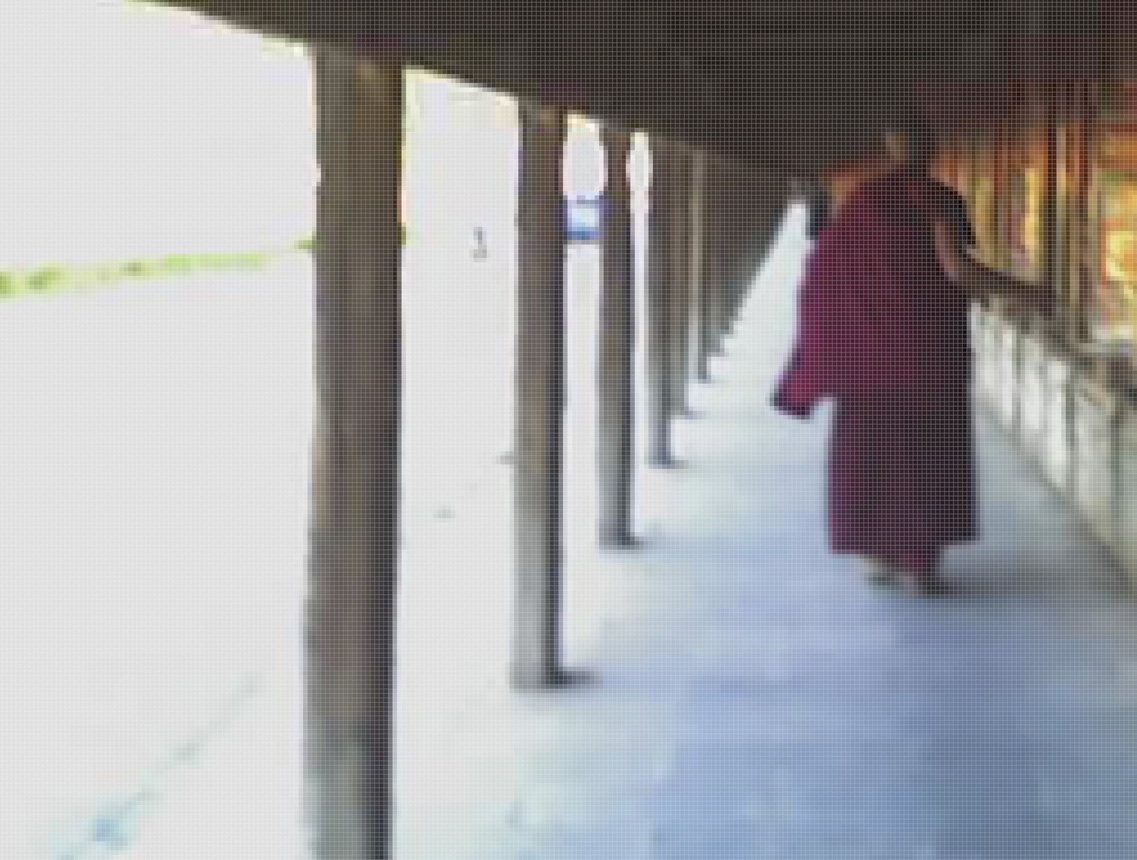
The starting material of this piece are two field recordings of the prayer wheels: the first one captures the wheels on the perimeter, right on the spot you see in the picture, focusing on one of them; the second one captures the sound of one of the big prayer wheels with the bell. When I recorded these sounds it was the 14th of August, the usual summer great buddhist ceremony had ended in mid July, and it was the morning of a common working day. Nonetheless during the hours I spent there the flux of practitioners was constant and the sound never dropped completely, except for rare exceptions never lasting more than one minute. The work insists on the interaction between real-time generated synthetic sounds and the field recordings. A first part is driven by the sound of the wheel on the perimeter, a second by the sound of the wheel with the bell. The recording is analyzed by the computer, and some parameters are extracted and mapped to the synthetic sounds. The analysis is basically reduced to the extraction of the squeak's pitch in the first part, and the onset detection of the bell in the second; the most of the interactive work is made in the mapping part. The two parameters were chosen to leave the rhythm fairly intelligible even in the most chaotic moments. The recordings are played back unedited, this does not mean that they are always hearable, but they affect the material almost everywhere, leaving unaltered all the rhythmic nuances of the real phenomenon.
Ultimately, Memories from Xiahe is about the thoughts I elaborated afterwards, when the memories of this apparently idyllic place merged with those of the Shanxi region and its noisy coal mines, and the chaos of Lanzhou. In an ingenuous -let alone unrealistic- effort of imagination I let the rhythm of the wheel shape the chaotic noise.